

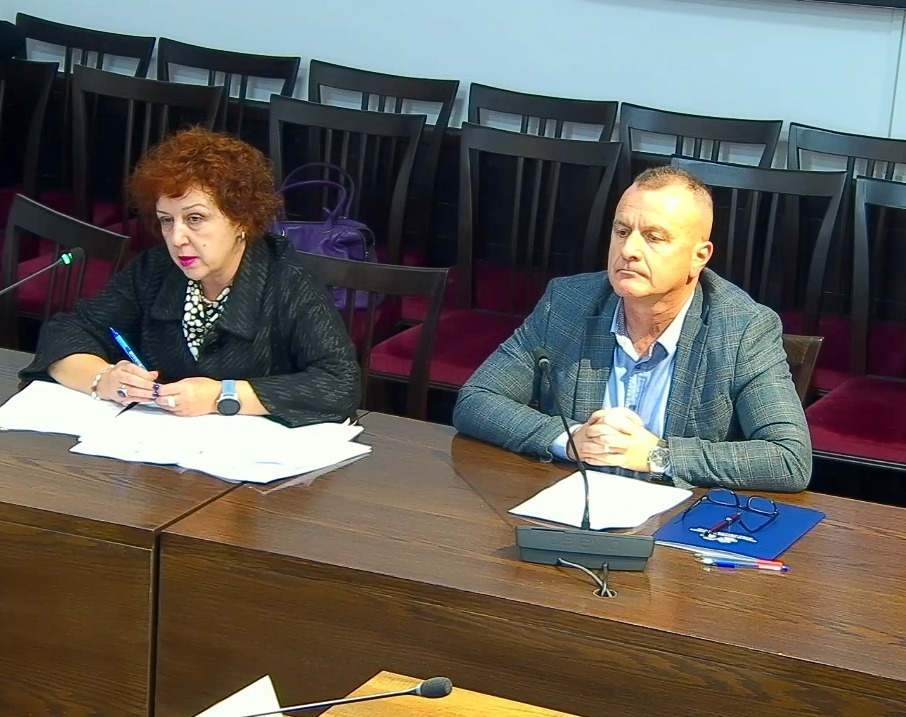
The American Chamber of Commerce in Albania participated in a hearing with stakeholders before the Parliamentary Committee on Economy, where it conveyed the concerns of its business community regarding the proposed amendments under the 2027 Fiscal Package. Represented by Executive Director Neritan Mullaj and Chair of the Tax Committee Alketa Uruci, AmCham presented its objections and recommendations, focusing on the impact of the proposed changes on businesses and the predictability of the fiscal system.
Executive Director Neritan Mullaj reiterated AmCham’s fundamental concern regarding the absence of a meaningful public consultation process for changes of this magnitude, which envisage a significant increase in the tax burden and directly affect business operations and companies’ plans. According to Mullaj, the proposals included in the Fiscal Package have not been accompanied by a comprehensive assessment of their economic and fiscal impact. Furthermore, insufficient consideration has been given to the potential for increasing budget revenues by broadening the tax base and combating informality.
Mr. Mullaj emphasized that these changes place businesses in a difficult position, particularly those that have developed their financing and investment plans based on an established fiscal framework and the objectives of the Medium-Term Revenue Strategy. Unexpected changes to these conditions force companies to revise their financial plans and reallocate resources to ensure business continuity. According to AmCham, this undermines fiscal predictability, which is essential for investment decisions by both domestic and foreign investors.
For her part, Chair of the Tax Committee Alketa Uruci focused on the technical aspects of the proposed amendments, highlighting issues affecting specific sectors and categories of businesses. She underscored the need for a clear implementation timeline for the new fiscal measures and the introduction of reasonable transitional periods.
According to Uruci, businesses have generated income and made financial decisions throughout the calendar year based on a specific tax regime, while the proposed changes could expose them to higher tax liabilities. A significant number of companies have developed their business plans based on the projections of the Medium-Term Revenue Strategy, which envisaged stable tax rates until 2029. Consequently, the proposed increases in VAT and dividend tax rates require companies to reassess their financial plans and existing commitments.
Addressing the proposed tax changes in detail, Uruci emphasized that increasing the standard VAT rate from 20% to 21% would affect a significant number of taxpayers who play an important role in the country’s economy. She also raised concerns about the frequent changes to VAT registration and application thresholds, which, in her view, have not delivered the expected results in formalizing the economy. On the contrary, these differences in tax treatment may create incentives for tax avoidance, including the splitting of larger companies’ operations into smaller entities to benefit from preferential tax treatment.
In this context, Uruci reiterated AmCham’s position on the need for a fairer and more transparent tax system that takes into account the characteristics of economic activities, profit margins, and investment levels. According to her, such an approach should ensure fair treatment of businesses, transparency in the application of tax obligations, and a more balanced distribution of the tax burden.
One of the specific requests presented to the Parliamentary Committee on Economy concerned the need to introduce transitional provisions for dividend taxation. Ms. Uruci proposed that companies generating profits during 2026, when the dividend tax rate is 8%, should be allowed to distribute those profits in 2027 while remaining subject to the same tax rate. Under AmCham’s proposal, the new 15% rate should apply to profits generated from 2027 onward, thereby avoiding the retroactive application of a higher tax burden on profits earned under the previous fiscal regime.
According to AmCham, the same principle should also be applied to the accommodation and hospitality sector. Companies operating in this sector have developed their business plans and entered into contracts with foreign tour operators based on the preferential VAT rate of 6%. An immediate change in tax treatment would create additional costs for contracts and commitments made under a different tax regime. For this reason, Uruci called for transitional provisions that would allow the implementation of the new rate to be postponed and existing contractual commitments to be protected.
Another issue raised before the Committee concerned the timing of the entry into force of the secondary legislation establishing the list of basic food products eligible for the reduced VAT rate of 6%. Ms. Uruci noted that while the Fiscal Package is expected to enter into force on January 1, 2027, the final list of products benefiting from the reduced rate is expected to be determined through implementing instructions in mid-January. This discrepancy between the law’s effective date and the publication of its implementing acts risks creating uncertainty and confusion for businesses. AmCham therefore called for the effective dates of the legal provisions to be aligned with those of the relevant implementing instructions.
Regarding policies aimed at supporting vulnerable households, AmCham considers that direct and targeted assistance to families most in need could be a more effective instrument for achieving social objectives. Alternatives discussed included direct subsidies for essential services, such as water and electricity, or increasing the budget allocated to social assistance, with the aim of directing support toward eligible households.
According to Uruci, reducing VAT to 6% on basic food products, while simultaneously introducing other tax increases affecting a significant proportion of businesses, could lead to higher costs and prices across various sectors of the economy. This could diminish the expected impact of measures intended to ease the cost of living for vulnerable households. Furthermore, a reduction in the VAT rate does not automatically guarantee that the benefit will be fully reflected in the final price paid by consumers.